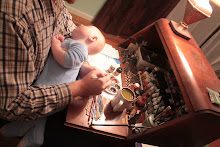
More of an ethnic group of Elves proper than their own race, Moon elves are characterized by long ears, pallid flesh, and ash blond or white hair. Most are thin and wasting, and yet tall, giving them a gaunt appearance. It is surmised that the name "Moon Elves" came from their physical appearance, rather than any connection to the moon, although due to their lack of pigmentation, the Moon elf is slightly more likely to be active during the dusk and night hours, as the midday sun, particularly near the equator, rapidly burns their fair skin. Many Moon elves wear large floppy hats or hoods during the day, and enveloping clothing to protect their fragile skin.
The important distinguishing feature of a Moon elf is not their appearance though, but rather their singular inability to see magic or magical effects. How this came to be is unknown, although various stories involving curses from the Titans, or blessings of Remoos are told around campfires late at night. More erudite theories involve magical creation, lack of a soul, and other darker speculations, but in reality no one knows. Rumors often connect the Moon elves to vampires, werewolves, necromancers, and other creatures of the night. What is known though, is that a Moon elf can not see things that are created by magic, nor the act of magic, nor magical illusions. While they can not see it, they are able to take advantage of its benefits, such as eating magical food, or receiving healing, and can certainly be struck dead by magical effects.
While for most Moon elves the inability to see magic is a handicap, there are a few that profit from this disability, by serving as guards, scouts, and in other positions where having someone see through a magical illusion is useful. In small numbers their inability becomes its own ability.
Given their obvious and characteristic physical appearance, Moon elves are easily distinguished from humans and other elves, even at a distance. They are often discriminated against when not in the City, due to the unsavory rumors which surround them, and while individuals may come to know a Moon elf like any other person, the uneducated, particularly in remote places fear and hate them. In some of the more remote areas of the world, there are even some who believe that Moon elves are themselves a source of magic, and they are often killed and eaten when caught by barbarian tribes.
Race Rules
In the Deepest Sea, Moon elves are limited in the classes they may take. They are unable to be magic users of any type, and can not cast magic as higher level members of other classes, nor may they read scrolls. On the other hand, they have a +1 against any harmful magical effects, and as mentioned above are not able to see illusions or other magical effects.
Like Elves, Moon Elves do not have infravision, instead they have keen vision, which accounts for their ability to spot hidden and secret doors. Moon Elves are able to see much further and more clearly than humans, particularly at night.
Like dwarves, Moon Elves do not have an experience cap, although their lust for adventure may serve as a cap, in that they are likely to die of it. More experienced elves have a tendency to want to return to the capitol city and live off of their stories, at least for a while. In addition, with every level gained above 3, elves have a 1/6 chance of becoming addicted to adventuring, meaning that they are not able to retire, even when they seek to do so. Unlike humans, or other races, PC elves are not likely to create strongholds, as they begin to get "itchy feet" and must go back to the dungeon or the frontier.
Showing posts with label Deepest Sea. Show all posts
Showing posts with label Deepest Sea. Show all posts
Friday, February 12, 2016

Tuesday, February 26, 2013
Character Advancement
Roger the GS is discussing how to handle prestige classes. A while back I had a post about dealing with prestige classes at 4th level, and sketched out a visual representation of that progression with its branches. Basically there are four classes at level 1, and at level 4 there can be up to 10.
Here is the current version in my Player's Guide. Each "step" has the title of the level, the XP, the HP, and any special skills or spells gained. Druids are a separate DM approval required class, and any 4th level player can decide to become a Bard (provided they can find a teacher, and have enough XP to enter the class etc). Dual classing can happen after 4th, and requires an equalization of XP once the new class "catches up" to the old one.
Here is the current version in my Player's Guide. Each "step" has the title of the level, the XP, the HP, and any special skills or spells gained. Druids are a separate DM approval required class, and any 4th level player can decide to become a Bard (provided they can find a teacher, and have enough XP to enter the class etc). Dual classing can happen after 4th, and requires an equalization of XP once the new class "catches up" to the old one.
 |
| Click to Enbiggen |
Labels:
Deepest Sea,
DnD


Wednesday, October 10, 2012
Gentlemen of the Road
On the recommendation of Ckutalik(via this post on historical fiction for fantasy readers), I requested the book Gentlemen of the Road by Michael Chabon from the local library. A short novel or novella, it is about the adventures of a Fafhrd and Gray Mouser type in the 950s in western Asia; a fairly gripping read, I knocked it out in a couple of hours. The book itself is lovely, with two color typeset, and illustrations by Gary Gianni, who is apparently currently working on the Prince Valiant comics in papers. I recommend it for those who like quick adventure stories.

However, like all good historical fiction, the real star is the setting, which here is Western Asia, and more specifically Khazaria, a Turkic empire established in 618 AD and lasted nearly 400 years. This empire existed as a sort of third wheel to the conflicts between the Eastern Empire to the west and the early Caliphate to the south, and contains names both known to most, and strange. The empire was multi-ethnic AND multi-faith, and had both a diverse economy and significant military activity. For a while at least the country had a dual kingship, with one king responsible for administration, and the other more of a figurehead (and held as a sort of prisoner in a palace). Unusually, the rulers of the country converted to Judaism in the 8th century, possibly as a way to stand in between their Christian and Muslim neighbors.
Frankly, I think it would be perfect for a theft and insertion into a D&D game, or possibly outright use in a more historical game. The silk road and the multi-ethnic nature of the empire make it perfect for any random character to show up, and there would be plenty of raids to defeat and convoys to attack. With place names that are both familiar and foreign, and with a history merely sketched in by a few primary documents, it has much to recommend it for adventure.
However, like all good historical fiction, the real star is the setting, which here is Western Asia, and more specifically Khazaria, a Turkic empire established in 618 AD and lasted nearly 400 years. This empire existed as a sort of third wheel to the conflicts between the Eastern Empire to the west and the early Caliphate to the south, and contains names both known to most, and strange. The empire was multi-ethnic AND multi-faith, and had both a diverse economy and significant military activity. For a while at least the country had a dual kingship, with one king responsible for administration, and the other more of a figurehead (and held as a sort of prisoner in a palace). Unusually, the rulers of the country converted to Judaism in the 8th century, possibly as a way to stand in between their Christian and Muslim neighbors.
Frankly, I think it would be perfect for a theft and insertion into a D&D game, or possibly outright use in a more historical game. The silk road and the multi-ethnic nature of the empire make it perfect for any random character to show up, and there would be plenty of raids to defeat and convoys to attack. With place names that are both familiar and foreign, and with a history merely sketched in by a few primary documents, it has much to recommend it for adventure.
Labels:
Deepest Sea,
DnD,
review
Friday, July 13, 2012
Rolang's Creeping Faith
Rolang, of Rolang's Creeping Doom, has been posting some great stuff lately in regards to Clerics. One of the most interesting is a form to help you figure out, or record, the details of a particular faith in your setting. If you are building a more structured, or at least non-gonzo world, inevitably you are likely to have a major religion, which has a structure, dictates, temporal power, and clergy (which may be where the clerics of your world come into the picture).
While many probably just run with a fantasy version of the Roman Catholic church circa 1200 with minor gods subbing in for saints, or possibly a Greco-Roman style pantheon, occasionally you want something more complicated, either for the RP purposes presented, or because it fits your setting better.
Enter this form, which helps you to work through the details of said religion, creating in effect a "character sheet" for it. Here is one for the Orthodox Shepardic religion in my Deepest Sea setting:
This looks like it could be useful, however, I wonder if it would make sense to use some of the ideas from Stars Without Number factions for the organization of the church itself, i.e. Hit Points, Force Rating, Cunning Rating, Wealth Rating, and FactionCreds, as well as Assets (armies, agents, and influence), and Tags (Machiavellian, secretive, plutocratic etc.) . Working with the SWN system in a fantasy setting should help to figure out how the organization interacts with other political players, and for a major world spanning faith, could be set up for functional sub-divisions, such as the church in a certain country, or a synod.
Anyway, food for thought, and certainly a useful tool.
While many probably just run with a fantasy version of the Roman Catholic church circa 1200 with minor gods subbing in for saints, or possibly a Greco-Roman style pantheon, occasionally you want something more complicated, either for the RP purposes presented, or because it fits your setting better.
Enter this form, which helps you to work through the details of said religion, creating in effect a "character sheet" for it. Here is one for the Orthodox Shepardic religion in my Deepest Sea setting:
|
Deity Name:
The Shepard
|
Pantheon:None
|
|
Titles,
Aliases:
|
Image or
Symbol: Crozier
|
|
Church
Name: Orthodox Shepardic Church
|
|
|
Domains
(Purviews): Creation
|
|
|
Alignment:
Lawful Good
|
|
|
Color: White
|
|
|
Special
Spells:
Remove
fear [plus 1 turn per level]
|
|
|
Forbidden
Spells:
Cause
wounds, other reversed spells
|
|
|
Rituals: Mass,
wind baptism, burial
|
|
|
Offerings:
Burnt livestock portions, money.
|
|
|
Special
Clerical Requirements:
Use of
blunt weapons, celibacy
Specific
orders may require poverty or other restrictions
|
Physical
Description:
The
Shepard is not depicted in person, but sometimes is seen as a cloud, or as a
man seen from behind with a flock.
|
|
Taboos: Dead
animals, blood
|
Notes:
Orthodox
oath: I will to my Lord and Master the Shepard, be faithful in all things,
love all which he loves and shun all which he shuns, according to His laws
and the order of the world. Nor will I ever with will or action, through word
or deed, do anything which is unpleasing to him, as He will hold to me as I
shall deserve it.
|
|
Enemies: Sufic
Shepardic tradition, other monotheistic religions
|
|
|
Attributes on scale of 1-20
|
|
|
Strictness
: 15
|
|
|
Jealousy :
16
|
|
|
Revelations
: 15
|
|
|
Organization
: 19
|
|
|
Wealth:
Astounding
at all levels, but diffusely spread amongst the various dioceses. Tithing is a set 10% of income.
|
|
|
Popularity:
Popular where ever humanity is found.
Particularly strong in Brémdy and Chénez (19), and large basilicas are
found there.
Less
popular in Turq lands (5).
|
|
|
Holy city
and places:
Empty
pastures, and churches, various sites related to saints.
|
|
|
Potential
Afterlife(s): The endless field, where humanity flocks together under his
guidance.
|
This looks like it could be useful, however, I wonder if it would make sense to use some of the ideas from Stars Without Number factions for the organization of the church itself, i.e. Hit Points, Force Rating, Cunning Rating, Wealth Rating, and FactionCreds, as well as Assets (armies, agents, and influence), and Tags (Machiavellian, secretive, plutocratic etc.) . Working with the SWN system in a fantasy setting should help to figure out how the organization interacts with other political players, and for a major world spanning faith, could be set up for functional sub-divisions, such as the church in a certain country, or a synod.
Anyway, food for thought, and certainly a useful tool.
Labels:
Deepest Sea,
DnD
Friday, June 22, 2012
Things what I noticed
Have not been keeping up with the old blogosphere, so there is plenty of interesting work out there that I did not notice when it was new and fresh.
Map Text Layout from FrDave.
http://bloodofprokopius.blogspot.com/2012/06/layout-experiment.html#comment-form
Where-in different columns are used to convey information to players and the DM respectively, and information rows are sorted by "obviousness". For example, a you might have basic room description as a player text box, and the size/secrets of the room as the DM. Monster physical description, and then monster stats, etc.
There is definitely something there about organization that I want to look into more, and being spreadsheet/box oriented, this appeals to me.
Classed based XP from Jeff Rients:
http://jrients.blogspot.com/2012/06/class-based-xp-shenanigans.html#comment-form
It seems to me that class based XP charts can be a fun addition to the game, particular in a more sandboxy setting, where you want the players to develop their own goals and plans. It may be important to try and structure the bonuses in such a way as to direct play in a positive way, where the party tries to work together, rather than against each other. I particularly like the idea of a pilgrimage XP bonus for cleric based classes.
While reading the comments, I also had the flash of how the "barbarians" of my Deepest Sea setting function. They have a gift based economy, with all of its attendant virtues and vices. Played properly, this pushes barbarian characters nicely into alien "otherness" without having to larder on a set of rules to make that happen. (not that there is anything wrong with more rules)
Map Text Layout from FrDave.
http://bloodofprokopius.blogspot.com/2012/06/layout-experiment.html#comment-form
Where-in different columns are used to convey information to players and the DM respectively, and information rows are sorted by "obviousness". For example, a you might have basic room description as a player text box, and the size/secrets of the room as the DM. Monster physical description, and then monster stats, etc.
There is definitely something there about organization that I want to look into more, and being spreadsheet/box oriented, this appeals to me.
Classed based XP from Jeff Rients:
http://jrients.blogspot.com/2012/06/class-based-xp-shenanigans.html#comment-form
It seems to me that class based XP charts can be a fun addition to the game, particular in a more sandboxy setting, where you want the players to develop their own goals and plans. It may be important to try and structure the bonuses in such a way as to direct play in a positive way, where the party tries to work together, rather than against each other. I particularly like the idea of a pilgrimage XP bonus for cleric based classes.
While reading the comments, I also had the flash of how the "barbarians" of my Deepest Sea setting function. They have a gift based economy, with all of its attendant virtues and vices. Played properly, this pushes barbarian characters nicely into alien "otherness" without having to larder on a set of rules to make that happen. (not that there is anything wrong with more rules)
Labels:
Deepest Sea,
DnD
Tuesday, May 15, 2012
Overland Travel
Travel is one of the areas of DnD that is least understood, because few of us have traveled to distant locations on foot, or by horseback. In this day and age of cars, fast trains, and faster jet planes, the amount of time that it takes to walk from point A to point B is not understood on an intuitive level. Consequently all of the various rules for overland travel give very high rates of progress, and have very few encounters per day, particularly when one considers the amount of territory crossed.
One way to handle the issue of too much distance covered is to reduce standard travel to, say 8 hours a day, so 8 leagues, or ~24 miles. [thank you Talysman for pointing out my error here] Pressed travel rates would be more hours per day, as you really can not hike much faster, but could do so for longer. Horses would allow for slightly faster travel, but not if heavily loaded, and not for more than the 8 hours without running the risk of killing the horses over more than one day of travel.
A way to handle the second issue is to increase the frequency of encounters, while at the same time making more of them non-combat related. Mixing in some mundane encounters like "peasants" or "attractive local features" allows for more creative descriptions and role play potential than "a hex of woods, no encounter" ever would allow for.
Telecanter has another way to deal with the tedium of travel, by making the upkeep and wear and tear into a sort of mini game, where the travel itself causes a sort of damage that needs to be allocated to the various aspects of travel, i.e. animals, gear, supplies. Traveling through areas like swamps, or desert, or in the winter cold would create more damage points, which then need to be allocated to the animals and gear until they are used up/die etc. Resting in good terrain for extended periods "heals" some of the damage.
I personally have been backpacking several times before, and it is amazing what adding a bit of altitude, 40 pounds of equipment, and reducing the amount of oxygen available will do to your endurance and your perception of the amount of ground covered. Walking as the only means of transportation, and having to lug a hauberk, sword, and a bundle of torches to the scary cave from which no man has returned... well, that would be pretty hard on the old body.
On another note, my friends from back east are going to be in town for a week or so, and there was talk of running a game which has me thinking about deep dark places in the earth, and what creepy things may be found there. I have been looking over real-life tomb maps, and it is easy to imagine how a few pit traps, animated skeletons, or falling ceilings could make them into death traps. Great risk for a possible great reward... sounds like a fun session to me, so we will see how it goes.
One way to handle the issue of too much distance covered is to reduce standard travel to, say 8 hours a day, so 8 leagues, or ~24 miles. [thank you Talysman for pointing out my error here] Pressed travel rates would be more hours per day, as you really can not hike much faster, but could do so for longer. Horses would allow for slightly faster travel, but not if heavily loaded, and not for more than the 8 hours without running the risk of killing the horses over more than one day of travel.
A way to handle the second issue is to increase the frequency of encounters, while at the same time making more of them non-combat related. Mixing in some mundane encounters like "peasants" or "attractive local features" allows for more creative descriptions and role play potential than "a hex of woods, no encounter" ever would allow for.
Telecanter has another way to deal with the tedium of travel, by making the upkeep and wear and tear into a sort of mini game, where the travel itself causes a sort of damage that needs to be allocated to the various aspects of travel, i.e. animals, gear, supplies. Traveling through areas like swamps, or desert, or in the winter cold would create more damage points, which then need to be allocated to the animals and gear until they are used up/die etc. Resting in good terrain for extended periods "heals" some of the damage.
I personally have been backpacking several times before, and it is amazing what adding a bit of altitude, 40 pounds of equipment, and reducing the amount of oxygen available will do to your endurance and your perception of the amount of ground covered. Walking as the only means of transportation, and having to lug a hauberk, sword, and a bundle of torches to the scary cave from which no man has returned... well, that would be pretty hard on the old body.
On another note, my friends from back east are going to be in town for a week or so, and there was talk of running a game which has me thinking about deep dark places in the earth, and what creepy things may be found there. I have been looking over real-life tomb maps, and it is easy to imagine how a few pit traps, animated skeletons, or falling ceilings could make them into death traps. Great risk for a possible great reward... sounds like a fun session to me, so we will see how it goes.
Labels:
Deepest Sea,
DnD
Friday, February 24, 2012
Utimately 20 Questions
Brendan, author of the blog Untimately, has created this questionnaire in a effort to create a list of rules which might change from campaign to campaign. Since it actually addresses somethings I am trying to work out, here are the answers for the Deepest Sea campaign at least.
- Ability scores generation method? Six rolls of 3d6 in order
- How are death and dying handled? Death at -10 HP, at 0 or below, the player bleeds out unless wounds are bound, and loses a further 1 HP per hour until they die even if bound.
- What about raising the dead? Yes, but rare, and very very costly.
- How are replacement PCs handled? Either taking over a hireling, or expedient discovery of a new character around the corner, in the cell, etc.
- Initiative: individual, group, or something else? Group
- Are there critical hits and fumbles? How do they work? Critical hits are essentially double damage, modified by DM fiat. Fumbles range from dropping weapons to causing damage on self/ally, dependent on circumstances.
- Do I get any benefits for wearing a helmet? Yes, protection from falling objects etc.
- Can I hurt my friends if I fire into melee or do something similarly silly? Sure can!
- Will we need to run from some encounters, or will we be able to kill everything? You will sure as heck need to run from some things, although I tend to roll low on monster hit dice.
- Level-draining monsters: yes or no? Yes, but recovered in one level per week, as per Beedo's house rules.
- Are there going to be cases where a failed save results in PC death? yes of course. Poison in particular.
- How strictly are encumbrance & resources tracked? Tracked roughly. If you do not have any food, you will starve, you have to have enough light generating objects etc. Encumbrance is tracked on the player's character sheet.
- What's required when my PC gains a level? Training? Do I get new spells automatically? Can it happen in the middle of an adventure, or do I have to wait for down time? You do not need training, unless you intend to switch classes (to a prestige class). Magic User new spells need to be found, but you will have new spell slots. Downtime is when the leveling happens.
- What do I get experience for? Killing things, treasure, some minor role-play bonuses. Oh, and carousing.
- How are traps located? Description, dice rolling, or some combination? Description of your actions.
- Are retainers encouraged and how does morale work? Yes, highly encouraged, and morale works in the normal fashion, when you are losing a fight, they may run, or if you give them the chance to steal, they may steal.
- How do I identify magic items? Some will be obvious (glowing, other unnatural aspects), but specific functionality will need to be researched. Some magic items are likewise non-obvious, and need to be researched as well. Sages and high-level wizards will research for you... and for a price.
- Can I buy magic items? Oh, come on: how about just potions? There are no "magic stores" that have racks of magic items, they are far to rare for that. You may be able to buy magic items from NPCs that own them, but only for exorbitant prices.
- Can I create magic items? When and how? Sure, at the levels indicated in the LL rule book.
- What about splitting the party? Yes, sure, but there will be risk in doing so.
Labels:
Deepest Sea,
DnD
Tuesday, January 17, 2012
Magic Item: Sunswords
Forged in the mythical antediluvian age by the elves of that time, Sunswords are a magic weapon without equal in the known world. They are each known to collectors by name, the history of each over the long thousands of years chronicled in the City by sages, great battles at which they appeared known to dreaming squires all over the world.
Finding an unknown Sunsword is correspondingly very rare. The majority of those known are in the hands of the Paladins of Red Bella, the Elvish God of War, and even then they rarely leave the Grand Armory-Cathedral in the City. News of finding a new sword in the human lands would mean that armies would march, and assassins, thieves and worse would be unleashed to recover the prize, for so great is their prestige that they are coveted by the kings of man... or those who would to become kings.
Yet, the Sunsword is not a mortal blade. They are made neither from bronze nor iron, rather their blade glows slightly, like unto the new dawning sun, white over the horizon. It is this three cubit blade from which their power comes, for the hilt is unremarkable, being nothing more than a cylinder etched for grip. There is no guard, no ornamentation, no gems, nothing besides the blade and the hilt. Nothing there is, besides the box.
Given time, the Sunsword cuts all things, and suffers no scabbard or belt, cutting easily through either. Instead, each is stored in a special white ceramic box, which grips the hilt tightly, letting the blade remain untouched. This box also blocks the unending light and faint hum generated by the blade, allowing its bearer to rest, and to carry the sword unremarked. The hilt does have a flat bottom, which can be used to rest the blade during a respite in combat, but many have died on their own blades, trying to regain them in a moment of panic, and the wise ignore this feature.
Sunsword, 1lb, d12+4 damage
Sunsword case, 5lbs
Finding an unknown Sunsword is correspondingly very rare. The majority of those known are in the hands of the Paladins of Red Bella, the Elvish God of War, and even then they rarely leave the Grand Armory-Cathedral in the City. News of finding a new sword in the human lands would mean that armies would march, and assassins, thieves and worse would be unleashed to recover the prize, for so great is their prestige that they are coveted by the kings of man... or those who would to become kings.
Yet, the Sunsword is not a mortal blade. They are made neither from bronze nor iron, rather their blade glows slightly, like unto the new dawning sun, white over the horizon. It is this three cubit blade from which their power comes, for the hilt is unremarkable, being nothing more than a cylinder etched for grip. There is no guard, no ornamentation, no gems, nothing besides the blade and the hilt. Nothing there is, besides the box.
Given time, the Sunsword cuts all things, and suffers no scabbard or belt, cutting easily through either. Instead, each is stored in a special white ceramic box, which grips the hilt tightly, letting the blade remain untouched. This box also blocks the unending light and faint hum generated by the blade, allowing its bearer to rest, and to carry the sword unremarked. The hilt does have a flat bottom, which can be used to rest the blade during a respite in combat, but many have died on their own blades, trying to regain them in a moment of panic, and the wise ignore this feature.
Sunsword, 1lb, d12+4 damage
Sunsword case, 5lbs
Labels:
Deepest Sea,
DnD,
item
Friday, January 13, 2012
A letter from a PC
I told my players that they could get an experience bonus for writing an in character letter recapping the adventure, which the magic user decided to make use of. The intent was to collect a bit more detail, have the players create some color, and hopefully, give me some devious hooks to us on them later.
Lord Oraculi,
I have recently come across magic that I cannot explain through my own studies, and I write this to you seeking answers as to what the magic is and guidance as to what should be done with the remnants of what I have found. Because my knowledge of the matter is so incomplete, it may help you to know under what circumstances the magic came into my possession.
While having a feast with the Baron, a human from a small town burst in and cried for help. His village had been attacked by the Thin Men. One of my party, I cannot tell you which due to mild intoxication, volunteered us to investigate the matter. After a cautious journey to the town we found that the vast majority of it had been burnt to the ground, save for the structures that were made of stone and therefore could not be burned and the palisade on the far side. Brief investigations of the remaining structures revealed that the people inside had been killed.
We managed to gain entrance into the palisade by climbing in and began investigating by looking in a small hole in the center. Our orc, Orgoyle, brash as she was (and still is, luckily) rushed to the bottom while the druid Aaganess' faery fire revealed three animated skeletons! Orgoyle was quickly defeated, her injuries life threatening. Another spell from the druid entangled the abominations and allowed us to retrieve the fallen orc. Our young woods people, Nyma and Ummm managed to gather herbs that kept the orc alive, as our demonstrative priest, Solamante, neglected to prepare his spells of healing. We searched the area, hoping to find a healing potion or some other way of keeping the orc alive, but we only found a giant spider and a ghoul (and some treasure) for our troubles. It was shortly after defeating the ghoul that I came across the first bit of that magic that has confounded me so. Once again, I cannot explain its nature other than to say that it filled me with a sense of contrariness, or even wrongness. My only deduction is that the magic is of a necromantic sort, as we had, at that point, come across two types of the undead.
We climbed a tower and saw that there was a quarry near to the village. The remaining party, Nyma stayed with the fallen orc, travelled there seeking more answers. What we found was the remaing villagers, slain and piled high like debris. Fearing what foe might have that kind of power, we retreated out of the village to try and restore the orc into usefulness. After a good deal of rest, the priest's magic revived Orgoyle, and in an effort to be at full strength when found our foe, we rested some more.
The following day we returned to the quarry and ventured into the hillside via a small fissure. Upon entrance we were accosted by a cave crawler. Fortunately, none were seriously injured, though the reinvigorated Orgoyle, with much to prove after her incapacitation, chased the poor creature as it tried to flee and slew it. What followed was a strange network of small tunnels and ancient rooms that was difficult to follow. I have done my best to recreate our journey in the underground after this letter, and have labeled everything as best I could. Of particular note, are the ancient elven tombs and the ancient underground cathedral.
We came across more skeletons as we entered the cathedral, and thanks to some creative tactics and some rather impressive slinging from Orgoyle's minion Bantha, they were easily dispatched. What we found at the far end of the cathedral is the most pertinent of all: we stumbled across a woman just before she sacrificed two humans, and surrounding her were zombies! The wicked wench charmed my own hireling, Sir Willy, and caused him to attack Orgoyle. That distraction would have been enough to fracture our party and end us if it hadn't been for Aaganess' quick thinking. Another spell of entangling brought Nature's fury of inconvenience on the necromancer and her minions, holding them fast where they stood. Orgoyle, having learned from her last bout of blade induced near-death, luckily wore a spare shield on her back. That shield likely saved her from Willy's wrath, and after trading blows, Sir Willy was felled by one of our rogues. Meanwhile, Umm and Aaganess had their dogs viciously attacking the Necromancer, and though she protected herself with the same magical shield you yourself taught me, the dogs brought her down.
The zombies were easily dispatched after the wicked woman was down. Most of it had been taken care of by the time I returned with a long spear to keep me out of reach. Solamante spoke to the woman as she lay dying, and when she mentioned having minions come to her aid, he smashed her skull with his mace.
Here are a few more points that require your guidance. The sacrificial area was lined with some kind dark magical script, likely to have the dead return to life after being slain. The Necromancer wore a necklace of human finger bones that named men and had the number 1. The Necromancer's spell book, while containing some benign spells, which I have already copied, also contained more of those that seemed to twist my sense of the natural order, which I have not copied. All of this took place in a cathedral that was likely used by elves ages ago, and contained small areas for each of the ten gods as well as others that we did not, and I suppose still do not, know about. One of the shrines was dedicated to Triton, who I know to be a banned god.
So there you have it, Oraculi. The entire experience unsettles me more than most. Who were the other gods? Why don't people know about them anymore? Where did this Necromancer receive her power and what could that mean for the future? I pray that you will give me the guidance I require to make the proper decisions regarding this tainted magic.
Ever Your Student,
Fondue
Labels:
Deepest Sea,
DnD
Thursday, January 12, 2012
Thoughts on the Session
As you no doubt read in great detail, the first Deepest Sea session ultimately went well. Here are a few thoughts from my point of view:
- I had a player interested in playing a Druid and a havling cleric, so I had to come up with information on both. Druids are based on the Advanced companion rules, and havling clerics are worshipers of the elvish pantheon. Both players did quite well with their choices.
- Players were confused about the "lines" thing with equipment and encumbrance. They were also somewhat confused about how to generate the various bonuses based on stats. Both need to be better explained in the players guide, possibly with examples.
- Buying equipment takes some time, and may need to be simplified for beginners with a "kit".
- I rolled the motivations of the retainers using the NPC motivation table created by Rolang, but the results were not as random as expected. Drop tables may have a bias due to methodology [I was dropping with my left hand, and most results went to dull and torpid]. As it happened, they only hired two retainers and a dog, so it did not matter much.
- The players did not go quickly to the village, which meant that they missed out on seeing the zombies and skeletons burn down the village, and also meant that the necromancer was encountered only at the end, and not as a reoccurring villain.
- The players never searched the ruins of the church, missing a large part of the potential loot.
- The first combat went pretty poorly, and the orc fighter went down as quickly as would be expected in a 3:1 situation. I was willing to let the character die, but the other players pointed out that having the character of the guy who flew 3000 miles to be in the game (not wholly for the game) die might not be the most fun. So apparently now we need to get to -10 to actually die. Ah, house rules!
- Instead of attacking the skeletons in the well, the players looked around for "healing potions".
- Spider and ghoul in the tower died very easily, showing the combat power of such a large party.
- The players never looked through the stables or the workers huts, instead hurrying off to the quarry.
- Once they recovered spells, they did not go back to the well, or to the previously found hole in the ground, but instead went to the cave with the slime trail (!). Might have to use that against them next time as a chance to introduce a TPK, or as I like to think about it "a life lesson".
- Cavern Crawler was weaker than I thought, and got spanked in one round by the massed firepower of the group, and then slain as it tried to flee.
- Entangle was very very powerful... when the DM forgets to roll a magic resistance for those hit by it.
- Players put down the necromancer very quickly, ending combat in three rounds. She also failed her blood sustenance spell because she missed her attack on the dog ripping her apart. This was disappointing, since I had hoped that this combat would be sort of the capstone of the session. Another instance of misjudging the power level of the party.
- Players are now going to carouse to ensure that they all make it to level 2... which gives me evil glee.
Labels:
Deepest Sea,
DnD
Wednesday, January 11, 2012
Deepest Sea Session Recap
I finally ran a game for my friends this past couple of weekends, over two sessions. Here is an exhaustive recap after the break.
Labels:
Deepest Sea,
DnD,
game session
Friday, November 18, 2011
Players guide v0.2

The threat ranking is based on the concept created by Roger here, and is located on page 29. As always, the various silhouettes are from Telecanter, and they are highly useful.
Please let me know what you think.
Labels:
Deepest Sea,
DnD
Saturday, October 29, 2011
On bases

Basing options are as follows:
20mm square
25mm square
20mm round
25mm round
30mm round
30mm round, dished
40mm round
25mm hex
Ideas? Thoughts?
Labels:
Deepest Sea,
DnD
Friday, October 28, 2011
How old is that Ruin?
 I am very very slowly working on my Deepest Sea Dungeon Master's Guide, but just to prove there is something going on, here is a d12 chart for "How old is that ruin that the PCs just found?"
 I tried to go for a slightly archaeological look, with the PC party peering down through the dirt through the depths of time to the ruins. As you can see there is a better chance of "really old" ruins than of recent human ruins, which seems reasonable.
Thanks again as always to Telecanter for the silhouettes.
I asked potential players about a New Years game, and have had positive response, so some miniatures are on the way for that, and it gives me a good goal for getting the DM's Guide and a revised Player's Guide finished.
Labels:
Deepest Sea,
DnD
Friday, October 21, 2011
Encounter Table - column shifting
I have been sort of quiet this week, in part because I have been working on this encounter table idea. The concept is that your encounter table for a certain large region includes all terrain types, and then there are column shifts from right to left or left to right to show changes in conditions, such as bad weather, or other situations where a normally safe area becomes more dangerous, or a dangerous area becomes more safe.
Ideally there would be a few more columns to show the differences between say, city and dangerous city, but I did not have 16 more ideas at this time! I also used 3d6 to make it more regular, and repeated entries to make it even more so. So there are lots of "peasant" entries. (roll on sub table). In addition, my entries are more naturalistic than fantastic, and there is very little on there which is straight magical... which I think fits the setting.
As always the excellent silhouettes are from Telecanter.
Any thoughts?
Also, a welcome to New Big Dragon, who has an interesting looking RPG blog. (which I am trying to resist reading before publishing this post)
 |
| (click to enbiggen) |
Ideally there would be a few more columns to show the differences between say, city and dangerous city, but I did not have 16 more ideas at this time! I also used 3d6 to make it more regular, and repeated entries to make it even more so. So there are lots of "peasant" entries. (roll on sub table). In addition, my entries are more naturalistic than fantastic, and there is very little on there which is straight magical... which I think fits the setting.
As always the excellent silhouettes are from Telecanter.
Any thoughts?
Also, a welcome to New Big Dragon, who has an interesting looking RPG blog. (which I am trying to resist reading before publishing this post)
Labels:
Deepest Sea,
DnD
Friday, October 14, 2011
Deepest Sea Players' Guide
Well, after a couple months of lunchtime and some side tracking, I have at last finished the players' guide to the Deepest Sea (Located here). This is intended for players in my Deepest Sea game, which I hope to be able to run over the holidays. The guide has a character creation sheet, and a character sheet, as well as equipment and spell lists, a progression chart, and some "fluff" on the nations, a bestiary, and assorted other bits of information for 18 pages in total. This was created using Microsoft Publisher, and then converted to PDF. The "art" is just placeholder art until I can draw and track down a few more fitting pieces.
I am standing on the shoulders of giants to make this guide, with information from a number of sources, prices inspired by Rob's draft Majestic Wilderlands price list, silhouettes from Telecanter, prestige classes from FrDave, and some layout ideas from Roger's single sheet project. Many thanks to those who knowingly and unknowingly helped so far.
Please take a look and let me know what you think. Now a short break, and then on to the DM's guide and the actual adventure.
I am standing on the shoulders of giants to make this guide, with information from a number of sources, prices inspired by Rob's draft Majestic Wilderlands price list, silhouettes from Telecanter, prestige classes from FrDave, and some layout ideas from Roger's single sheet project. Many thanks to those who knowingly and unknowingly helped so far.
Please take a look and let me know what you think. Now a short break, and then on to the DM's guide and the actual adventure.
Labels:
Deepest Sea,
DnD
Friday, September 16, 2011
Character Sheet
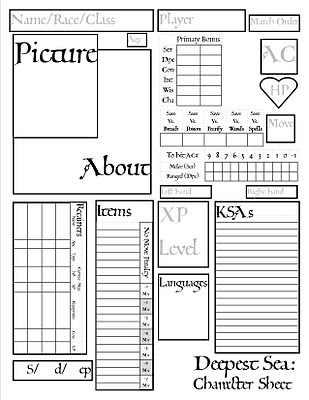
Building from my one page character generation, I have been working on a character sheet. The concept is to have everything that a player needs on one sheet, and further, all the "core" data needed to play in a single quadrant of the page.
I still need to work on the "fluff" quadrant, which is pretty basic right now (and fairly unattractive) .
Other design choices:
Silver pennies are the main coinage used in the Deepest Sea, so instead of a box to track GP, we have S/d/cp
Retainers are placed on the character sheet
Encumbrances are handled by lines in the item list, so that a character loses one move (5 feet) for every two lines filled. Heavier items take up more lines.
Spells, skills, and such like are in KSAs
Anyway, here is what it currently looks like:
Let me know what you think. Any suggested refinements? Improvements? Something I forgot? Would it be useful for new players?
Also, welcome to new follower Lum. Hope you see some stuff you like here!
I still need to work on the "fluff" quadrant, which is pretty basic right now (and fairly unattractive) .
Other design choices:
Silver pennies are the main coinage used in the Deepest Sea, so instead of a box to track GP, we have S/d/cp
Retainers are placed on the character sheet
Encumbrances are handled by lines in the item list, so that a character loses one move (5 feet) for every two lines filled. Heavier items take up more lines.
Spells, skills, and such like are in KSAs
Anyway, here is what it currently looks like:

Let me know what you think. Any suggested refinements? Improvements? Something I forgot? Would it be useful for new players?
Also, welcome to new follower Lum. Hope you see some stuff you like here!
Labels:
Deepest Sea,
DnD,
old school,
planning
Wednesday, August 31, 2011
Character Generation

Above, for your consideration is a draft Character Generation sheet that I have created in MS Publisher. [click to enlarge] Please note that it uses the wonderful silhouettes created by Telecanter for a little atmosphere.
What do you think? Is this sufficiently useful for both newcomers and those with significant experience in newer editions? Suggestions for improvement? (aside from cleaning up the statblocks) Any obviously missing items?
Labels:
Deepest Sea,
DnD,
old school,
planning
Saturday, April 30, 2011
Zagyg
Z is for Zagyg in the twenty sixth and final installment of the Deepest Sea, A-Z.
Zagyg is the legendary first Titan, or in some versions, the first magic users amongst the Titans. In any case, he is credited with teaching the other Titans magic, and luring the Elves into slavery. The first he did by learning from demons, and then using the power granted by subjugating the demons to influence the other Titans. The Elves he lured by the sheer magnetism that magic held for them.
Zagyg's reign lasted for centuries, and then he departed. Not much is known of this period, but the wisest of sages, those who have read the Titan scrolls, or explored the depths of the long abandoned, but not empty research pits, say that he left, alone, and walked back to the legendary city in the far south that the Titans came from. The Empire sent expeditions after him in its early years, hoping to thus end the Titan threat all together, but none ever returned. Occasionally their bodies are found frozen in sea ice, mangled and screaming in terror.
Over time, most forgot the name of Zagyg, but somewhere, somewhere in the cold of the southern pole, he might still carry on as a lich, still consorting with demons, still wresting a little bit more magic out of a universe which commands him to die.
Next time, a roundup of the A-Z project, and a review of the results for April.
Zagyg is the legendary first Titan, or in some versions, the first magic users amongst the Titans. In any case, he is credited with teaching the other Titans magic, and luring the Elves into slavery. The first he did by learning from demons, and then using the power granted by subjugating the demons to influence the other Titans. The Elves he lured by the sheer magnetism that magic held for them.
Zagyg's reign lasted for centuries, and then he departed. Not much is known of this period, but the wisest of sages, those who have read the Titan scrolls, or explored the depths of the long abandoned, but not empty research pits, say that he left, alone, and walked back to the legendary city in the far south that the Titans came from. The Empire sent expeditions after him in its early years, hoping to thus end the Titan threat all together, but none ever returned. Occasionally their bodies are found frozen in sea ice, mangled and screaming in terror.
Over time, most forgot the name of Zagyg, but somewhere, somewhere in the cold of the southern pole, he might still carry on as a lich, still consorting with demons, still wresting a little bit more magic out of a universe which commands him to die.
Next time, a roundup of the A-Z project, and a review of the results for April.
Labels:
AZ,
Deepest Sea,
DnD
Friday, April 29, 2011
Yeomen
Y is for Yeomen in the twentyfifth installment of the Deepest Sea A-Z.
Yeomen are a rank of society between the nobility and the common peasant. They own land which they derive income from, but are not nobles. In most countries they make up the upper class of villages, together with artisans and petty clergy. Typically they are more likely to be selected by the baron as a bailiff, or elected by the other peasants as reeve, depending on the system used in that area. The amount of land owned varies, but is typically more than any one peasant would work, meaning that their family is at least twice as prosperous as a common peasant.
Yeomen typically have military responsibilities to the baron, or to the kingdom. What this entails varies from area to area, but typically they are required to be trained with a bow, and often have other weapons on hand. When the baron goes to war, yeomen are required to accompany him, although they are often paid waged for this service, beyond some basic defence of the barony. In Brémdy, where the population is wealthy and many rank as yeomen, some even own armor and horses, and serve as secondary knights, in support of the nobility, who maintain better equipment and horses. In this role, they are often called "sergeants". In other kingdoms this term is used for yeomen who lead small groups of men.
In a city, or large town, the term yeoman is not often used, as few own land, and instead all are ranked as burghers together. Naturally, some are poor, and some are rich, but in general all are wealthier than serfs in the small villages, and all have more cash at hand, even if it is only a few coppers. One's job, or guild membership becomes more important in determining relative social standing, although this does tend to map out to wealth as well.
The ranks of men:
Slave
Indentured man
Serf
Free Peasant
Yeoman
Squire
Knight
Baron
Tune in Saturday for the final episode of the Deepest Sea A-Z, with Zagyg.
Yeomen are a rank of society between the nobility and the common peasant. They own land which they derive income from, but are not nobles. In most countries they make up the upper class of villages, together with artisans and petty clergy. Typically they are more likely to be selected by the baron as a bailiff, or elected by the other peasants as reeve, depending on the system used in that area. The amount of land owned varies, but is typically more than any one peasant would work, meaning that their family is at least twice as prosperous as a common peasant.
Yeomen typically have military responsibilities to the baron, or to the kingdom. What this entails varies from area to area, but typically they are required to be trained with a bow, and often have other weapons on hand. When the baron goes to war, yeomen are required to accompany him, although they are often paid waged for this service, beyond some basic defence of the barony. In Brémdy, where the population is wealthy and many rank as yeomen, some even own armor and horses, and serve as secondary knights, in support of the nobility, who maintain better equipment and horses. In this role, they are often called "sergeants". In other kingdoms this term is used for yeomen who lead small groups of men.
In a city, or large town, the term yeoman is not often used, as few own land, and instead all are ranked as burghers together. Naturally, some are poor, and some are rich, but in general all are wealthier than serfs in the small villages, and all have more cash at hand, even if it is only a few coppers. One's job, or guild membership becomes more important in determining relative social standing, although this does tend to map out to wealth as well.
The ranks of men:
Slave
Indentured man
Serf
Free Peasant
Yeoman
Squire
Knight
Baron
Tune in Saturday for the final episode of the Deepest Sea A-Z, with Zagyg.
Labels:
AZ,
Deepest Sea,
DnD
Subscribe to:
Posts (Atom)