Thursday, April 26, 2012

Isometric Dungeons

Telecanter, of the awesome silhouettes, has a couple of recent blog posts about drawing isometric dungeons, which give the illusion of depth to your maps.

Very cool, and it seems like the basics of this technique would work when done by hand, or with layers in a GIMP/Photoshop sort of way.

The aptly named Fantastic maps shows some of the basic steps involved:

1: Draw Map, 2: Rotate Map, 3: Magic!


This may be what I need to get me to finish the semi isometric tomb map I have been idly sketching on a post-it for a few months.  Then I can get on to trying to kill the players with it.

Dungeon Master for Dummies

Thwarted in my quest to read D&D material from the local library due to lost or stolen material, I settled for the Dungeon Master for Dummies book by Bill Slavicsek and Richard Baker, written for Dungeons and Dragons version 3.5.  I had pretty low expectations for this book, and it took me quite a number of lunches to get through, but here are some thoughts:

Much is made of the concept of "DM as social director" where the DM is essentially hosting a party and providing for the entertainment of same. This makes sense if the DM is actually the host, but it seems like there must be groups that meet at clubs/game stores who follow a different arrangement, and someone else is the host and the DM is the "entertainment" for the get together.  Still, in game, the concept makes sense, as the DM needs to juggle the personalities of the players to make sure everyone is having "fun" (or otherwise deriving benefit from play). 

Feeding into this concept of the DM as entertainer is the idea that the DM is not trying to kill the player characters, but rather, allowing them to play.  There is some discussion of when to allow the dice to kill PCs and when to fudge things.  An interesting idea on keeping players engaged is to have them recap previous sessions at the start of the next session.

The book effectively summarizes the bloat issues of 3.5 edition by discussing the addition of a class to your game.  When adding a class, you are not just adding a single option, but rather dozens due to class/race/feat permutations.  An example is given where adding a race is too "powerful", by suggesting a Medusa sorcerer.  (actually, I want someone to make a Flailsnail character of that one)

The book includes some random dungeon material, which could be useful to add to other tables you have for that purpose.  Also has random encounter tables, and random treasure, as well as a number of "ready to go" encounters and traps with stats and details for 3.5.

The book has a chapter discussing high level play issues, which are different than in earlier editions of D&D, given the power increase of the characters with feats and various powers.

An interesting section of the book discusses how to have a memorable villain, which I think all longer term games could benefit from, even if they are sandboxes.

I do not want to put everyone off this book, but rather suggest that it was not for me.  If you were completely new to DMing, and did not spend a year reading blogs on the Internet before doing it, you could read this book and get some useful advice.  For me though, it was mostly repetitious of things I have already read or learned on my own, and a bit too specific to the challenges or running a 3.5 game.

In other news, still have not had the time/motivation to paint, so that is nearly four months without touching a brush.  Not a great state to be in, particularly when I had three largish projects I wanted to accomplish this year (baneblade, D&D figures, and Dreadfleet).

Thursday, April 12, 2012

Ogre Kickstarter

You may recall that last year, I had a post about 6th Edition Ogre (the game with giant robotic death tanks, not one about dim witted large fellows with clubs).  It was supposed to come out in the fall of 2011, but funding was apparently an issue, and it has not happened yet.

Here is a reminder of what it is going to look like:


Well, now that Kickstarter is apparently a thing (or is trying to be), Steve Jackson games is using it to help get their 6th edition of the game off the ground, and ideally to include extras.  They have already reached the first funding goal, so the game will be able to go forward, the only question remaining, is what extras will it contain?  With 29 days to go, they should be able to get at least a few more bucks...

Wednesday, April 4, 2012

Game of Thrones

I have long been a fan of the Song of Ice and Fire universe, ever since I got all three of the first books, and read them in a week while my then girl friend (now wife) was out of town, and I was sick and bored. The gritty realism is of course part of the draw, but the characters are another.  I got through all three books, and then was eager for #4, which came out that fall. (a quick peek at amazon indicates that it was 2005, so nearly 7 years ago).  The long delay from Feast to Dance sort of cooled things off for me, and I have not thought as much about Westeros lately.

In any case, the wife and I have just started watching the Game of Thrones TV show, and it has rekindled some of that heady feeling I had when I crammed in 2400+ pages in a week. (Astonishing my wife's cousins who are devout fans of the series) Naturally, as these things go, I started to think about how to game the series, and what miniatures to use...

Obviously, there are the official miniatures from Dark Sword, and while they are generally lovely, they are quite large, expensive, and not suited for gaming in my opinion.  (although still retaining utility for characters and unusual types)

Fortunately, the Westeros way of war seems to be broadly similar to the War of the Roses/mid Hundred Years War here on earth, that is to say "high medieval" in arms and armament, minus, of course, guns and cannon (so 1420-1450).  So full harness for well-to-do types, mail and partial plate for those poorer, and cloth and helmets for the lower level retainers.  Fantasy elements are limited, particularly in the first three books, with valarian steel swords being the main thing needed.  Heraldry from here and from this amazing map.

The Perrys have a lovely series of figures that would fit in well here, in the shape of the War of the Roses line.  The plastic boxes for this yield archers, Men-At-Arms, billmen, pike men, and crossbows. Metals fill in a few of the other needed elements, and the Hundred Years War line would provide for the poorer lords' forces. 

Gaming wise, I would use the LotR skirmish game engine, which allows for low powered heroes and warbands.  Figures would be assembled into groups, representing minor lords and their retainers, which should allow for surmountable painting as well. (I would make mostly Northers, Riverlands, and Lannister allies) Larger games could be accommodated by the same engine, or by moving to the WotR mass battle game, although I do not foresee things getting that out of hand...

Obviously I am treading the same path that many have gone before, such as this recent thread on The Miniatures page. (or this older one) Or the several lovely threads on Lead Adventure (This one, Stark, Lannister, plus Captain Blood's WotR figures)

Now I just need to finish off about 25 other projects, and I can move on this one!

Wednesday, March 21, 2012

Perry Plastic Men At Arms

As some of you probably noticed over on The Miniatures Page, the Perry Brothers have announced that the Mounted Men at Arms will be available at Salute, and that if you buy three boxes, you get a "free" Charles the Bold figure also, which is pretty cool.  I should probably paint one of my existing knights regiments before buying a new one, but these are pretty good looking figures, and should work nicely with my Empire/DOW army, as well as being useful for various historical battles.  I have frothed over these figures before, but they look great, and you should buy some.  [12 Knights and horses for £18]

Also, I apparently missed Conquest Sac again, which probably says more about my attention to conventions than about their advertising.  Looks like a good time was had, and Black Cavalier reports that attendance seems to be up as well.  Maybe next time then.

We have been sick at our house, so not much hobby activity going on, which will hopefully change soon when the taxes are filed.

Wednesday, March 7, 2012

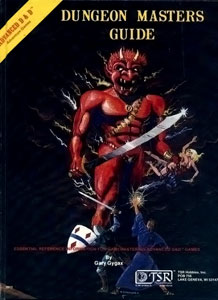
Dungeon Masters Guide


I finally finished reading the Dungeon Masters Guide (DMG), which I got through the magic of inter-library loans. The copy I read was the revised edition from December 1979, and was in pretty flawless condition considering the age. This is my first exposure to the book, as I was far too young to play AD&D when this book held sway.

I suspect that most of you have read this book before, if you do not own it, so no need to recap its contents, but suffice it to say that it is a fairly comprehensive collection of tables and rules for running an AD&D game, hampered by a lack of organization, and a primitive layout.

An interesting aspect of this book is that it clearly strives to present itself as "official" in a way that modern books do not. Modern RPG books either assume that you are only going to use the book you are reading, and make no mention of other books, or present their ideas as a menu from which you can pick and choose. The DMG is very strident in stating that it is the only way to do things... even while saying that "in your world you may do things differently".  I suspect this has something to do with the various clone and competing games that were starting to appear at the time of its publication.

Another aspect of the book, is that it is significantly less "generic" than most modern fantasy RPG books. By this I mean that even though most fantasy books have an assumed setting, it is expressed in such a way as to make it fairly easy to reshape. The world of the DMG is not presented in this fashion, instead, it is concerned with handling the minutia of planes, spell interactions, and potion creation. This presents a magic heavy world in a way that would take some work to refine down to a low magic world.

All in all, this is a useful book for a DM, and even if you are not playing an AD&D game, there is some utility to be had here, if only for the random tables, and it is something that I am looking forward to adding to my permanent collection, even though I doubt that I will ever play the rules as written herein.

The next book I am trying to get from the library is the Monster Manual II, so we will see how that goes.

Friday, February 24, 2012

Utimately 20 Questions

Brendan, author of the blog Untimately, has created this questionnaire in a effort to create a list of rules which might change from campaign to campaign.  Since it actually addresses somethings I am trying to work out, here are the answers for the Deepest Sea campaign at least.

  1. Ability scores generation method? Six rolls of 3d6 in order
  2. How are death and dying handled? Death at -10 HP, at 0 or below, the player bleeds out unless wounds are bound, and loses a further 1 HP per hour until they die even if bound.
  3. What about raising the dead? Yes, but rare, and very very costly.
  4. How are replacement PCs handled? Either taking over a  hireling, or expedient discovery of a new character around the corner, in the cell, etc.
  5. Initiative: individual, group, or something else? Group
  6. Are there critical hits and fumbles? How do they work? Critical hits are essentially double damage, modified by DM fiat.  Fumbles range from dropping weapons to causing damage on self/ally, dependent on circumstances.
  7. Do I get any benefits for wearing a helmet? Yes, protection from falling objects etc.
  8. Can I hurt my friends if I fire into melee or do something similarly silly? Sure can!
  9. Will we need to run from some encounters, or will we be able to kill everything? You will sure as heck need to run from some things, although I tend to roll low on monster hit dice.
  10. Level-draining monsters: yes or no? Yes, but recovered in one level per week, as per Beedo's house rules.
  11. Are there going to be cases where a failed save results in PC death? yes of course.  Poison in particular.
  12. How strictly are encumbrance & resources tracked? Tracked roughly.  If you do not have any food, you will starve, you have to have enough light generating objects etc.  Encumbrance is tracked on the player's character sheet.
  13. What's required when my PC gains a level? Training? Do I get new spells automatically? Can it happen in the middle of an adventure, or do I have to wait for down time? You do not need training, unless you intend to switch classes (to a prestige class).  Magic User new spells need to be found, but you will have new spell slots. Downtime is when the leveling happens.
  14. What do I get experience for? Killing things, treasure, some minor role-play bonuses. Oh, and carousing.
  15. How are traps located? Description, dice rolling, or some combination? Description of your actions.
  16. Are retainers encouraged and how does morale work? Yes, highly encouraged, and morale works in the normal fashion, when you are losing a fight, they may run, or if you give them the chance to steal, they may steal. 
  17. How do I identify magic items? Some will be obvious (glowing, other unnatural aspects), but specific functionality will need to be researched.  Some magic items are likewise non-obvious, and need to be researched as well.  Sages and high-level wizards will research for you... and for a price.
  18. Can I buy magic items? Oh, come on: how about just potions? There are no "magic stores" that have racks of magic items, they are far to rare for that.  You may be able to buy magic items from NPCs that own them, but only for exorbitant prices.
  19. Can I create magic items? When and how? Sure, at the levels indicated in the LL rule book.
  20. What about splitting the party? Yes, sure, but there will be risk in doing so.
I am currently slowly reading through the Advanced Dungeons and Dragons Dungeon Masters guide, so some ideas come from there, and the rest of them I blame on you fellow OSR bloggers.

Thursday, February 16, 2012

Monster Manual, 4th Edition


No, not Type IV 4th edition, 4th edition of the original Advanced Dungeons and Dragons Monster Manual, published when I was but a year old.  Thanks to the miracles of intra-library loans, I have been looking through it this week. I was pretty excited to get it, since I have never read any of the original AD&D material, instead having first come into the hobby with 2nd Edition, and mostly with modern retro-clones like Labyrinth Lord.

The presentation in this book is fairly standard, in that it has a stat block, description of the creature and its abilities, any special notes about occurrence etc, and occasionally a picture.  Surprising to me at least, was that the stat block does not have any XP information.  Some groups of like monsters are grouped together, so that "devils", "dinos", and "demons" can have their general rules explained up front.  (although this is not true for "undead" or "pre-historic" for example).  Another interesting aspect is that monster damage is not mentioned in terms of dice types (d4-d20), but rather as damage ranges.  This is probably due to the lack of polyhedral dice at the time, but it does make for a bit of extra work to convert 2-8 to 2d4 say, and some of the damage ranges do not convert nicely in to dice types.

The art in the book is... variable.  The pieces by D.A. Trampier are generally good to excellent (in particular the Were-rats and Rakshasa), where as the majority of pieces by D.C. Sutherland III are... poor (dragons in particular).  They do generally convey the idea of the creature though, and fit the sort of pseudo-late medieval milieu that Gygax seems to have run his games in, and they have a sort of enthusiastic nature that makes some of them charming.

An interesting aspect is that the last couple pages of the book are a catalog of all TSR Fantasy and Science Fiction games available at the time, which reminds you that there were briefly at least, THREE versions of D&D in print at the same time. (AD&D, Basic, and Original).  There is also an advertisement for GenCon, then owned by TSR.

Compared to modern works, the 1979 book is hardly state of the art.  If someone published this now, you would consider it "amateur" and probably would not pay more than $5 for a PDF copy.  Desktop publishing has advanced significantly in the last 10 years, never mind in the last 30. Yet, it is pretty easy to see how this would have been revolutionary at the time it was first published, in particular as an advancement on small stapled booklets.  If you have not checked it out, you should, just to see how far things have come.

Yesterday I got the original AD&D DM's guide, also from intra-library loan, so I am pretty excited to read that next.

Friday, February 3, 2012

Space Ship Interiors

Due the popularity of Space Hulk, and Alien/Aliens (one may be more popular than the other), space ship corridor systems are quite popular.  People want to take the flat tiles from space hulk similar games, and translate them into three dimensions to add even more color to their games.  (and probably because they want their little dolls to have better displays).

A new entry into the space corridor system market is GameCraft, which by all appearances is exploding into the scenery scene lately.  They have recently released a system of Space Ship Interiors, which have all of the usual hallways, intersections, and small rooms you might expect, plus some detailing tiles, improved doors, and some exterior details which give a nice look to the walls.  Also available in a smaller size too, for 15mm figures.

The genius part though, is this, they have a micro sized planning kit, which has multiples of all the various pieces, and allows you to plan your layout in advance, and all the pieces are numbered, which match numbers on the normal corridor pieces.  And it is to scale.  Very smart.

Someone put some serious thought into this system, and were I to buy a set of space corridors, this is the one I would go for. Obviously the price adds up, but it looks great... and I do already have all those stormtroopers...

Wednesday, February 1, 2012

Santa Delivers!

Sort of.  Rolang, of Rolang's Creeping Doom, asked his readers to challenge him to create tables for them, as a way to jump start some of his own creativity, and get back into blogging.  And he donated $1 to charity for each request.  How cool is that?

Today, my turn came up, and I got the 3d6 table of hireling motivations of my dreams.  Perfect for a traditional fantasy game (no gonzo entries), and this will work quite well next time my players are hiring anyone.

You can view the rest of his creations Here.